Thursday, May 10, 2012

Mary in May, The Night of 1,000 candles

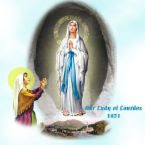
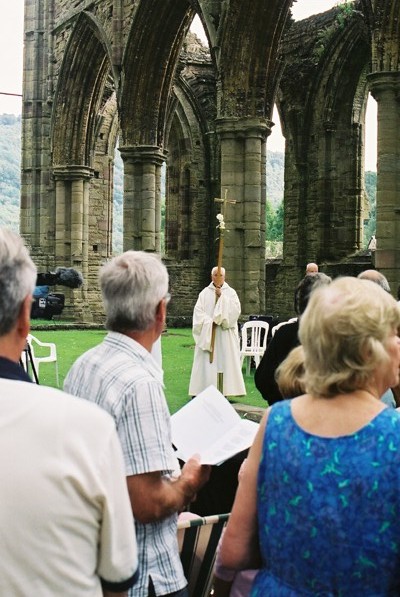
Last night,i n spite of a very damp evening, nearly a thousand people turned up to Belmont Abbey for the famous May procession to honour Mary, the human mother of Our Lord, Jesus Christ. People met at Hedley Lodge, for an
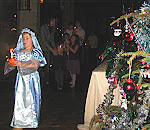
 evening meal or tea and cake and then assembled at nine o'clock at the gates of the Abbey. People turned up in coaches, cars, minibuses and everywhere was packed. At the gates, people bought Lourdes candles and paper cups in which to shield them from the wind.

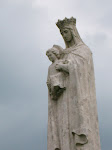
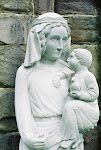
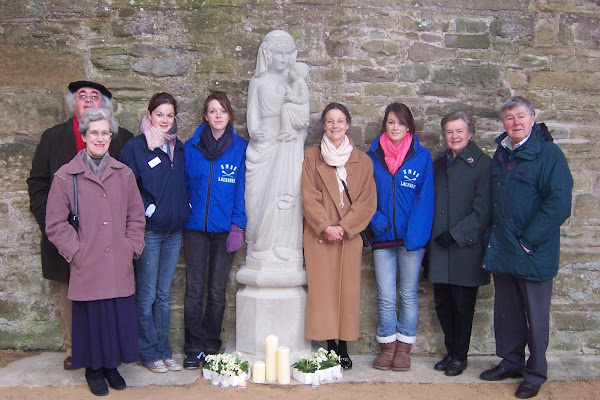
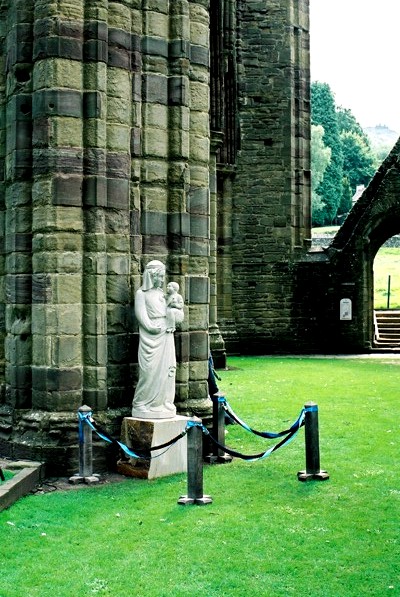
Abbot Paul Stoneham welcomed all the pilgrims , who had come from as far as Swansea, and also from Bromyard in Herefordshire and all joined in a rousing series of hymns thanking Mary for her 'Yes' to God's plan which overturned Eve's disobedience in the Garden of Eden. We were graced with the presence of the Lord Archbishop of Cardiff, whose birthday it was and who joined in the hymns with equal fervour to the Welsh, who were in good voice. The processional statue of Our Lady was borne aloft, decked with many different sorts of flowers, roses, carnations lilies many other varieties and was illumined. We walked around the huge garden, and recited the Glorious Mystery of the Rosary. In fact this carrying of the statue and the singing and prayer very much called to mind the Ark of the Covenant, the powerhouse of the ancient Israelites at the beginning of our Plan of Salvation, before whom David danced. Mary was of the House of David, and is often called the 'Tower of David' as one of that line's most glorious creations.

During a homily in the Abbey Church, Archbishop George gave an inspirational homily,recalling our 'journey' through the garden .He reminded us, that our Salvation had begun in the Garden of Eden. Eve too had been conceived without sin, because God had done this for Adam and Eve but, after Eve's disobedience, another woman,Mary in her immediate obedient  'yes' to the Angel Gabriel had brought the possibility of restoring us to Eden. The story of  Salvation, moved to a close in another garden, that of Gethsemene,where Jesus was arrested, before his death on the Cross for our Salvation.

The Angel called Mary 'Blessed' and so we call her Blessed Mary or 'Blessed Mother' and in fact Mary herself says 'All generations shall call me blessed' in her Song of Praise, the Magnificat.

In watching the procession move around, I was mindful of the Ark being carried by the Israelites.

It was made of gold  and was Ancient Israel's symbol of the Presence of God, as it contained
 The Ten Commmandments of the Law of Moses,
The Rod of Aaron, the High Priest
An Urn containing the Manna from Heaven ,
 which the ancient Israelites had been dropped from Heaven to physically eat in the desert to stay alive, when God saved them from starvation. Jeremiah had hidden the Ark from the invading Babylonians and said that the Ark would come back when the Tabernacle, which had been OVERSHADOWED by the Glory Cloud (Holy Spirit) it when it was set up would once again come down.
When King David brought the Ark to his new centre, Jerusalem, David greeted it and said "Who am I that the Ark of the Covenant should come unto me?" and then leapt in front of it with joy. (Compare Mary's cousin's greeting (Elizabeth)  'Who am I, that the Mother of my Lord should come unto me?', and the baby 'leapt' in her womb.
In the book of Revelation (means Apocalypsis-Unveiling) Chapter 11 John saw the Temple open and the Ark of the Covenant. The scene then reveals  the Woman clothed with the sun and twelve stars around her head, 12 Apostles, 12 Tribes-His Body on earth crowning Mary. The Woman was in Childbirth and giving birth to God's Son and the Beast was waiting to eat her child, but it was  taken back to heaven. The image of the crowning with stars is also similar to inside the Holies in the Temple where the Ark was kept, there was a curtain that depicted the sun, the moon, stars  to show God's temple was above the earthly Temple , which had been like a dim image in a mirror of the heavenly temple.
Mary made her long visit, (as probably a 15 year old girl,) from Nazareth (a town named after 'Nezzar'-'Shoot, 'A shoot shall spring forth out of the stem of Jesse' (Isaiah)to the town in Judea where Elizabeth lived. The Ark of the Covenant had also made its journey from the North of Judea to Jerusalem, which is in Judea.
The Shikenar Glory Cloud,(Holy Spirit) has now again descended and OVERSHADOWED the NEW ARK, as Archbishop George reminded us, which is one of Mary's titles-The Ark of the New Covenant.
 It OVERSHADOWED the Blessed Virgin Mary when she consented to do God's will and enthusiastically obeyed God's call, and made possible for us to have with us the Lord Jesus Christ. The word overshadowed only ocurrs in Greek on these two occasions in the Bible. God needs our co-operation to be present on earth and she is our most wonderful example of a saint, living out god's Life in her.. We venerate her as a unique human saint, alive in heaven with her Son.
The Queens of the House of David, were never the consorts or wives, always the Mothers of the present King (Solomon with Bathsheba), who are recorded in the House of David, along with the Kings. This Queen-Mother was called the 'Gabirah' and this is how early Jewish Christians would have understood the role of Mary, mother of the King. At the Wedding at Cana she said to Jesus, that the people needed wine and then 'Do whatever He tells you' to the servants .Little mortal human Mary, chosen by God for this important plan of Salvation loved God totally.
. Mediaeval writers called her the 'Spotless Rose' (from Isaiah) set to Music by Herbert Howells, this is a beautiful hymn.
Little human Mary was the NEW ARK.
Because Mary held in her womb and heart - JESUS, the Lord's anointed, as
1) The Word of God, the Wisdom of Christ
2)The True High Priest and Victim (he inaugurated the Lord's Supper and died for our sins on the Cross-once and for all.The Fourth Cup of Consummation of the Passover, was taken in the form of a bitter wine held on a sponge, after which he said 'It is accomplished'-(fulfilled'- You will be my People and I will be your God )
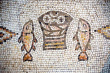
3) The Eucharist,the Thanksgiving Meal. Jesus was born in BETH-LEHEM (Town of BREAD) which was David's City. He is our physical food and is with us to the End of Time.He was laid in a feeding trough- a 'manger' (Fr 'to eat').
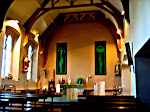
Inside the Abbey the statue was set up behind the altar, and lit up, just like the golden Ark, and everyone sang Hymns of Thanks and Praise to God for his gift of Mary providing a man's body for God in her Son. This Mystery of the Incarnation was observed in ancient poetry and texts of the ancient Welsh people, who called Jesus 'Mary's Son'.
Thank you Mary! for doing what you did!
After Archbishop George had preached, all turned to face the statue and give thanks in a hymn.At the end of the hymn 'Bring Flowers of the Fairest!' thousands of rose petals descended on the Statue representing Mary (New Ark).This was a wonderful moment.  The Old Pagan practice of the Queen of the May had been turned to a ceremony of Thanks, decking Blessed Mary with beautiful flowers and thanking her for her obedience, which has had a wonderful blessing for us all for the last 2,000 years.
Throughout the Veneration, the candles had been kept burning and the whole Abbey church shimmered.From everyone, a thank you for your words 'Ecce ancilla Domini'-behold the Handmaid of the Lord, Let it be done to me, according to your Word'. The little handmaid's words to us 'Do whatever he tells you....from the Book of John ask us to be obedient too....can we be as obedient as she is? We can only try.
At the end of the devotion, we all left and Archbishop George greeted us all singly  and went to the refectory for refreshments, after which I understand, the faithful sang 'Happy Birthday to You' to Archbishop George.
In spite of the dampish weather , we left with sounds of the hymns in our ears. We had a  SUPERB Organist who played Widor's Toccata at the Recessional and accompanied all the inside hymns fervently and with great 'hwyl' and verve-which added a great deal to the fantastic singing, the scent of the many flowers, the images of the hundreds and hundreds of glowing candles and the smiles on all the faces, the Sisters of Charity, the many priests nuns and other brothers and sisters who took part, all these were in our hearts and ears. I really felt little Mary was there amongst us joining in the fun and pointing us, as she always does to her son, our God and her God'.

Do whatever he tells you.......

Thanks from all the Pilgrims for the Faith and Catechesis through popular piety and in other ways,and an excellent retreat programme, to Abbot Paul and all the monks of Belmont for their service and care.


Wednesday, February 29, 2012

HAPPY ST DAVID'S DAY to ALL- MARCH 1st

Today is St David's day and there will be celebrations all over Wales. His defence of Catholic teaching earned him his canonisation by Pope Callixtus II.He lived for a while in Caerleon and also in Llanthony where he had a little hermit's cell. This is the article from the Old Catholic Encyclopedia.
(DEGUI, DEWI).

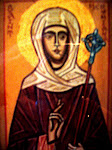
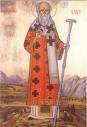
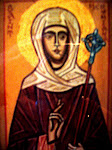
Bishop and Confessor, with St Winifred ,patron of Wales. He is usually represented standing on a little hill, with a dove on his shoulder. From time immemorial the Welsh have worn a leek on St. David's day, in memory of a battle against the Saxons, at which it is said they wore leeks in their hats, by St. David's advice, to distinguish them from their enemies. He is commemorated on 1 March. The earliest mention of St. David is found in a tenth-century manuscript Of the "Annales Cambriae", which assigns his death to A.D. 601. Many other writers, from Geoffrey of Monmouth down to Father Richard Stanton, hold that he died about 544, but their opinion is based solely on data given in various late "lives" of St. David, and there seems no good reason for setting aside the definite statement of the "Annales Cambriae", which is now generally accepted. Little else that can claim to be historical is known about St. David. The tradition that he was born at Henvynyw (Vetus-Menevia) in Cardiganshire is not improbable. He was prominent at the Synod of Brevi (Llandewi Brefi in Cardiganshire), which has been identified with the important Roman military station, Loventium. Shortly afterwards, in 569, he presided over another synod held at a place called Lucus Victoriae.(Llan-dewi brefi) He was Bishop (probably not Archbishop) of Menevia, the Roman port Menapia in Pembrokeshire, later known as St. David's, then the chief point of departure for Ireland St. David was canonized by Pope Callistus II in the year 1120.
This is all that is known to history about the patron of Wales. His legend, however, is much more elaborate, and entirely unreliable. The first biography that has come down to us was written near the end of the eleventh century, about 500 years after the saint's death, by Rhygyfarch (Ricemarchus), a son of the then bishop of St. David's, and is chiefly a tissue of inventions intended to support the claim of the Welsh episcopate to be independent of Canterbury. Giraldus Cambriensis, William of Malmesbury, Geoffrey of Monmouth, John de Tinmouth, and John Capgrave all simply copy and enlarge upon the work of Rhygyfarch, whilst the anonymous author of the late Welsh life printed in Rees, "Cambro-British Saints" (Cott. manuscript Titus, D. XXII) adds nothing of value. According to these writers St. David was the son of Sant or Sandde ab Ceredig ab Cunnedda, Prince of Keretica (Cardiganshire) and said by some to be King Arthur's nephew, though Geoffrey of Monmouth calls St. David King Arthur's uncle. The saint's mother was Nonna, or Nonnita (sometimes called Melaria), a daughter of Gynyr of Caergawch. She was a nun who had been violated by Sant. St. David's birth had been foretold thirty years before by an angel to St. Patrick. It took place at "Old Menevia" somewhere about A.D. 454. Prodigies preceded and accompanied the event, and at his baptism at Porth Clais by St. Elvis of Munster, "whom Divine Providence brought over from Ireland at that conjuncture", a blind man was cured by the baptismal water. St. David's early education was received from St. Illtyd at Caerworgorn (Llantwit major) in Glamorganshire. Afterwards he spent ten years studying the Holy Scripture at Whitland in Carmarthenshire, under St. Paulinus, (Pawl Hen), whom he cured of blindness by the sign of the cross At the end of this period St. Paulinus, warned by an angel, sent out the young saint to evangelize the British. St. David journeyed throughout the West, founding or restoring twelve monasteries (among which occur the great names of Glastonbury, Bath, and Leominster), and finally settled in the Vale of Ross, where he and his monks
lived a life of extreme austerity. Here occurred the temptations of his monks by the obscene antics of the maid-servants of the wife of Boia, a local chieftan. Here also his monks tried to poison him, but St. David, warned by St. Scuthyn, who crossed from Ireland in one night on the back of a sea-monster, blessed the poisoned bread and ate it without harm. From thence, with St. Teilo and St. Padarn, he set out for Jerusalem, where he was made bishop by the patriarch. Here too St. Dubric and St. Daniel found him, when they came to call him to the Synod of Brevi "against the Pelagians". St. David was with difficulty persuaded to accompany them; on his way he raised a widow'son to life, and at the synod preached so loudly, from the hill that miraculously rose under him, that all could hear him, and so eloquently that all the heretics were confounded. St. Dubric resigned the "Archbishopric of Caerleon", and St. David was appointed in his stead. One of his first acts was to hold, in the year 569, yet another synod called "Victory", against the Pelagians, of which the decrees were confirmed by the pope. With the permission of King Arthur he removed his see from Caerleon to Menevia, whence he governed the British Church for many years with great holiness and wisdom. He died at the great age of 147, on the day predicted by himself a week earlier. His body is said to have been translated to Glastonbury in the year 966.


Tuesday, February 21, 2012

Miserere Mei (Psalm 51) from Westminster Cathedral

http://www.youtube.com/watch?v=Dbv4o1h4rKQ&feature=fvst

The Ashing of the Sinners- Ash Wednesday, the Beginning of Lent


--------------------------------------------------------------------------------------------------------------------------------------------------------------------------------------------------------------------------------------


Have mercy on me, O God, according to thy great mercy. And according to the multitude of thy tender mercies blot out my iniquity.
2 Wash me yet more from my iniquity, and cleanse me from my sin.

3 For I know my iniquity, and my sin is always before me.

4 To thee only have I sinned, and have done evil before thee: that thou mayst be justified in thy words and mayst overcome when thou art judged.

5 For behold I was conceived in iniquities; and in sins did my mother conceive me.

6 For behold thou hast loved truth: the uncertain and hidden things of thy wisdom thou hast made manifest to me.

7 Thou shalt sprinkle me with hyssop, and I shall be cleansed: thou shalt wash me, and I shall be made whiter than snow.

8 To my hearing thou shalt give joy and gladness: and the bones that have been humbled shall rejoice.

9 Turn away thy face from my sins, and blot out all my iniquities.

10 Create a clean heart in me, O God: and renew a right spirit within my bowels.

11 Cast me not away from thy face; and take not thy holy spirit from me.

12 Restore unto me the joy of thy salvation, and strengthen me with a perfect spirit.

13 I will teach the unjust thy ways: and the wicked shall be converted to thee.

14 Deliver me from blood-guiltiness, O God, thou God of my salvation: and my tongue shall extol thy justice.

15 O Lord, thou wilt open my lips: and my mouth shall declare thy praise.

16 For if thou hadst desired sacrifice, I would indeed have given it: with burnt offerings thou wilt not be delighted.

17 A sacrifice to God is an afflicted spirit: a contrite and humbled heart, O God, thou wilt not despise.

18 Deal favourably, O Lord, in thy good will with Sion; that the walls of Jerusalem may be built up.

19 Then shalt thou accept the sacrifice of justice, oblations and whole burnt offerings: then shall they lay calves upon thy altar.

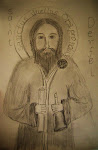
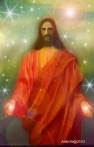
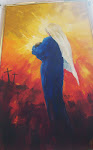
Last painting by Ashraf Gery. Thank you Ashraf-beautiful

PANCAKES AND REPENTANCE - GROSMONT AND SHROVE TUESDAY-ARE YOU ABOUT TO BE SHRIVEN?


--
--


Secondary School Childrens race.& nbsp;       This was a fine bunch of people, who raced from the Town Hall behind  down the road to the church. There was great fun and great enthusiasm, especially when the dog ate the pancakes that fell on the floor. The little boy cried but was given another pancake.
Women's Race

 Men;s Race-winning Contestant

---


Junior race Winner and runner up.....I think he was quite disappointed!

It was a pleasure to see such kind and welcoming people and the children, without attitude and with plenty of fun taking part in a local festivity. They were polite and yet really enjoyed themselves, shrieking with laughter.
Male finalist


Finalists in the Childrens Race

The Road at dusk D

Today is Shrove Tuesday and up and down most of Christendom, is the final day to eat up all the rich foods before the Lenten fast and to go to Confession and be 'Shriven' of your sins before Ash Wednesday (tomorrow) The confession aspect of tthe day is not available to all, being confined to when the priest is available for most in the many penetential Rites available in all parishes. I have put a list of reconciliation times at the bottom of this blog. If you would like me to include your parish or any penetential service, or it there is any inaccuracy, please let me know.

 People used to have a half day off work in Britain . Usually the church bell rang at 11am. Pancake races are still run in many places.Indeed the popularity of the pancake races and making of pancakes in neighbourhoods, care homes and all over has not died out.

Clarkes, the Newport based food manufacturing plant have reported record sales for the Canadian Maple Spirit this week.They are said to be working round the clock to fill the orders for the four leading supermarket chains. Schools also take the lead in keeping the custom going!

 Abergavenny Tithe Barn have published a recipe for this years' pancakes and  there are more races at South Cerney, Gloucestershire from All Hallows Church at 3.30pm, and at St Margaret's Chapel (next to Our Lady of Glastonbury Catholic Church) at 3.30. I shall be travelling to Grosmont this afternoon to see the races there.

The tradition is said to have originated when a housewife from Olney in Buckinghamshire was so busy making pancakes that she forgot the time until she heard the church bells ringing for the service. She raced out of the house to church while still carrying her frying pan and pancake. Pancake races in Olney can be dated back to 1445- in Catholic times.


The first pancake recipe was in a cookbook dating back to the 1439. Over the years this custom has been kept and modern runners now dress as traditional housewives with aprons ands bonnets whilst holding their frying pan. Pancake Day race rules state that they must at least toss the pancake at the start of the race and at the end of the pancake day races.
Shrove Tuesday is a term associated in English-speaking countries, Other Countries have, of course, Carnival and Mardi Gras.It is noted in Britain in histories going back to 1000AD, but may have been much earlier in the aural tradition.Making and eating the pancakes was considered the last feast which would be restricted during Lent.The date of Shrove Tuesday depends on the date of Easter and based on cycles of the moon.
There are Penetential Masses in all parishes this Lent, which will be published on the Churches Websites.Unfortunately some of these are not up to date, and cannot be accessed.
CWMBRAN NP44 3LTOur Lady of the Angels confessions (reconciliation)  Sats at 12noon -12.30
NP7 5UD Our Lady and St Michaels   Abergavenny, not sure
NP20 ITP St Mary's Stow Hill Sats 10.05-11.45
NP10 9DW St Basil and St Gwladys, Tregwylym Rogerstone Tuesday 6.30-6.50
NP20 3AQ  St David's Park Crescent Monday 6.30-6.50
NP20 7DX  St David Lewis, Bettws Newport  6.30-6.50
NP4 6HL  St Alban's Pontypool       5.30-5.40
NP4 9RA St Felix, Saturday after morning Mass
NP20 2BZ St Michaels Newport. Wed 6.30-6.50.
NP25 3BD   Saturday  St Mary's Monmouth 11-11.30  and on Request
And finally....a recipe!
  • 110g plain  flour
  • 2 eggs
  • 200ml milk mixed with 75ml water
  • 50g butter
  • pinch of salt

Gently melt the butter (30 secs in microwave) or in a pan. Sift together the flour and salt. Crack the two eggs into a dish and mix thoroughly and then pour into a well in the middle of the flour (make this with a spoon)Whisk in the eggs gently so that there is a creamy runny mixture.Put 2 tablespoons full of butter into the pan and then keep the rest of the melted butter for the frying pan.Get the pan really HOT and then TURN DOWN THE HEAT . Put two tablespoonfuls of the mixture into the pan, after the butter has completely lubricated it and move the pan around to make sure the whole of the base of the pan is covered.With a palate knife , gently keep the pancake moving until it is firm enough to flip over or toss over (if you are brave!) Serve with anything you like!


Wednesday, February 1, 2012

The Passing of a truly wonderful priest and confessor at Belmont Abbey

Father Dyfrig Harris
Monmouthshire Monk Priest, from Cwmbran, Torfaen. Requiescat in Pace

Right:St Dyfrig of Ergyng, Bishop of Llandaff

http://www.youtube.com/watchv=6hh_irzH7yo&list=UU_fY_pyY33755pFgGP8rKfw&index=1&feature=plcp

.

The Benedictine Community have lost one of their Brethren, to a stroke quite suddenly on 23rd of January. I drove down to the Abbey at Belmont today in glorious sunshine, and thought how fitting it was, that although extremely cold, the heavens were smiling on us, and on father Dyfrig. To my surprise I found he was christened Kevin Harris and attended Our Lady's church in Cwmbran, where he was Christened and  confirmed and then at Pontypool. certainly I would never have guessed he was from Cwmbran. Jovial, laughing and and extremely kind Confessor, with real concern for the faithful he served, he will be sorely missed by us all-his stints at Abergavenny during the penetential masses in particular, because these were where I cam into contact with him.

There was no room in the car park, and I walked back up through the graveyard to the Abbey Church and soon the procession of clergy entered, Abbot Paul being last . There were also representatives from the Ukrainian Catholic Church, which Father Dyfrig loved, having been to the Ukraine, and able to chant the liturgy. A sizeable number of the Ukrainian Catholics were also in the congregation. The Abbey church was packed with people standing at the back and sides and all the chapels full. During Father Abbot's moving homily, you felt a real sense of loss, echoed in the emotional letter written by his brother Michael later after the mass. Dyfrig was a Welsh priest from Madley just down the road from Belmont, who became Bishop of Llandaff. (no myth here-it is fact) The hymns chosen, 'Jesu Lover of my soul' , 'Soul of my Saviour' and 'Guide me ,O thou great Redeemer' were all well known and fervently sung, and the plainchant music written out for us in a beautiful booklet meant that most participated in the Ordinary of the Mass, which was largely sung. Father Dyfrig's brother and sister in law Jean and their families sat at the front, obviously distraught and our sympathy and love went out to them.

The gospel lesson from St John 14:1-6 was

'Do not let your heart be troubled
Trust in God still and trust in me
There are many rooms in my Father's house
If there were not, I should have told you
I am now going to prepare a place for you
And after I have gone and prepared you a place,
I shall return to take you with me
so that is where I am
you may be too
You know the way to the place where I am going.

Thomas said 'Lord, we do not know where you are going
so how can we know the way?'
Jesus said
I am the Way and the Truth and the Life
No one can come to the Father, except through me.'

The commendation was sung 'Receive me Lord and I shall live, and do not disappoint me in the promise you have given me'.

There followed the Byzantine Rite Commendation and the Christos Aneste, sung in Greek.

Finally, as the coffin was carried out from the church, the In Paradisum
In Paradisum deducant angeli; in tuo adventu suscipiant te martyres, et perducant te in civitatem sanctam Ierusalem.
Chorus Angelorym te suscipiat, et cum Lazaro quondam paupere, aeternam habeas Requiem.

As the Abbey church doors were open, the departing procession was bathed in bright sunlight, including Father Dyfrig's coffin- a great sign and a great blessing as a great priest, humble and human was carried out. I breathed the words:

'Well done, thou good and faithful servant'.
St Dyfrig         Pray for him
St Benedict     Pray for him
St David         Pray for him
St Winifride, Pray for him.
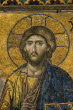
                                          Above Christ Receives Fr Dyfrig
 Left: St Michael

Tuesday, January 17, 2012

BRYNGWYN, An ancient Church on a White Hill and Cistercian Grange

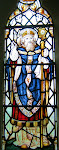
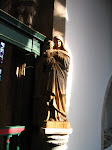
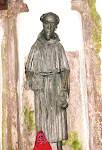
< St Peter as Pope in Bryngwyn Church

Ancient Welsh Studies.co.uk points to two men of Gwent, the first born c. 1045 and the father of Sir Gwyn, and secondly, the father of Aeddan who was born around 1135 and AEDDAN ap Gwaethfod a King of Gwaethfod . These Gwaethfods lived originally in Tegeingl and identify the earliest Gwaethfoed of Gwent as "ap Gwyn ap Glyddien (Cloddien) ap Gwybedydd ap Gwrydr Hir ap Caradog ap Lles Llyddog “ and believe he (or an intermediate ancestor) took up residence on the family's paternal lands in south Powys when other branches of the family remained in Tegeingl. This is not quite the story given by Sir Joseph Bradney,of a marauding Cardiganshire raider but fits in better with the family history.


They  give the possibility that when his lands were overrun by Normans and incorporated into Shropshire, That KingGwaethfoed moved south looking for new lands.He appealed, the Ancient Welsh Studies site say, on  entering the north of Upper Gwent , to King Ynyr ap Cadwgan, and was given Merwydd ferch Ynyr as wife and lands where White Castle was later built. 

It is even possible Gwaethfoed came to Gwent as an invader/squatter and avoided armed conflict with its king by agreeing to marry Ynyr's daughter. Ynyr is dated  to c. 1030 and Merwydd to c. 1060 .The Theory that Merwydd married a Gwaithfoed of Gwent seems more reasonable, both as to geography and chronology.  His only known son is called Sir Gwyn, born c. 1075, builder of Gwyn's Castle now known as ‘White Castle’ (white also being the translation of ‘Gwyn’. )

So much for the genealogy of Gwyn. About the year 1100, Sir Drew de Baladon (or Balun) invaded upper Gwent as a retainer of the Marcher Lord Roger fitz William fitz Osbern. Ynyr and Gwaithfoed,confronted them but it apppears bloodshed was averted by both Welshmen for their sons to marry de Baladon's daughters. Sir Gwyn ap Gwaithfoed married Emma de Baladon. Sir Dryw ap Gwaithfoed was probably his son, who was father to Aeddan,  born around 1165.
Aeddan , seemingly by now seems to be living at Grysmwnt or Grosmont, grew up a pious and faithful youth. He is mentioned in the Journey through Wales by Gerald the Welshman. I have already blogged about the route that (Catholic) Archbishop Baldwin of Canterbury took through Gwent from Llanthony, Patrishow (St Issui’s Shrine)Monmouth, Abergavenny, Usk, Newport etc. This Aeddan took the cross from Baldwin, becoming a Crusader knight. The ceremony was performed as Baldwin, accompanied by Gerald the Welshman, Archdeacon of St David’s was proceeding from Abergavenny to Usk.

.........a certain nobleman of those parts named Arthenus came to the Archbishop ,who was proceeding towards the castle of Usk and humbly begged pardon for having neglected to meet him sooner. Being questioned as to whether he would take the cross, he replied ‘That could not be done without the advice of his friends’, The Archbishop then asked him, ‘are you not going to consult your wife?’ He modestly answered, with a downcast look. ‘When the work of a man is to be undertaken, the counsel of a woman ought not to be asked’ and instantly received the cross from the Archbishop’.....(The itinery of Archbishop Baldwin(Third Crusade 1188)

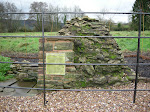
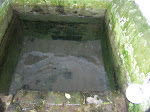
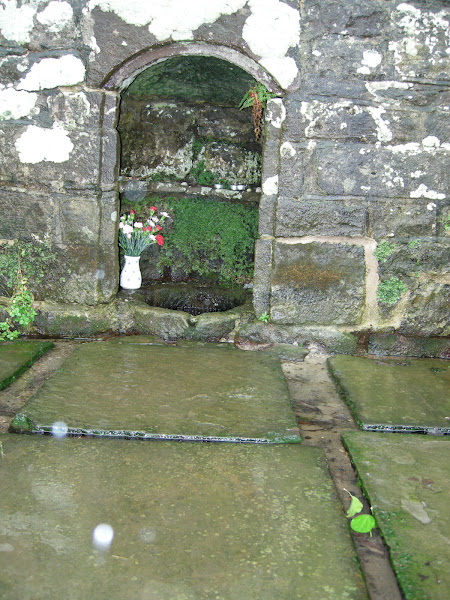
It is recorded, that soon after this, fired by his commitment, Aeddan and his sons founded three new chapels (which may have been founded on more ancient sites)Aeddan’s Chapel in Clytha, Bettws Newydd Chapel (Bettws Fovour Aeddan)(Bettws is a corruption of Bet-Haus-ancient for House of Prayer) and Bryngwyn Chapel,  which he dedicated to St Peter.) (Cambria Triomphans by Percy Enderby 1661 p 250)He held the manor of Clytha by payment of a sparrow hawk and granted out his lands to his relatives to hold by suit of court and a red rose (which was his badge)The Papal charters were given for this by Pope Honorius II and given to Aeddan by Teilo.The family supported the church and its Holy Well (St Peter’s Well-300 yards SE from the Church)and the church and manor were administered by the abbot and Community of Llantarnam. The church was likely to have been served with priests from Llantarnam also.
Some of the possessions of the Abbey of Llantarnam in Bryngwyn descended to the co-heirs of the manor of Wentesland and Bryngwyn . Lower Ty Mynach House in 1845.The small farm called Brynhyfryd was part of Lower Ty mynach.(Monks' House) The house was built on the site of two original cottages.The Chapel Farm, so called because of the association with the monastery, descended with the manor.It is likely they appointed local men as parish priest.
 
Following the collapse of the rural economy with the Black Death, and depletion of priests and monks and finally the Reformation, Clytha, seems to have collapsed, and the other churches taken over by Henry VIII’s new church. The tithes were formerly paid to the priory at Abergavenny but now paid directly to the Crown’s commissioners.
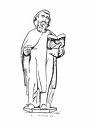
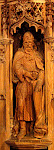
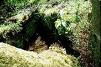
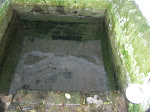
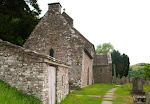
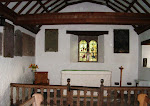
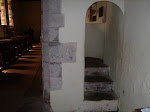
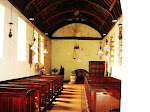
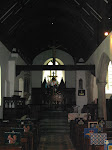
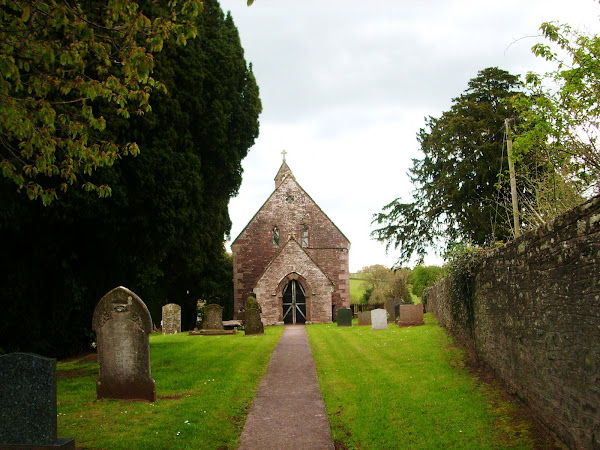
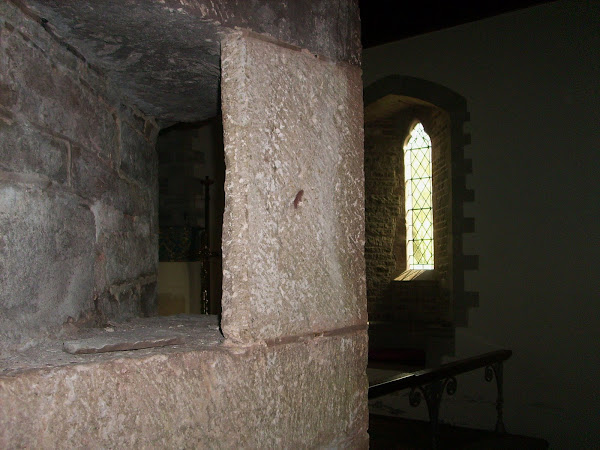
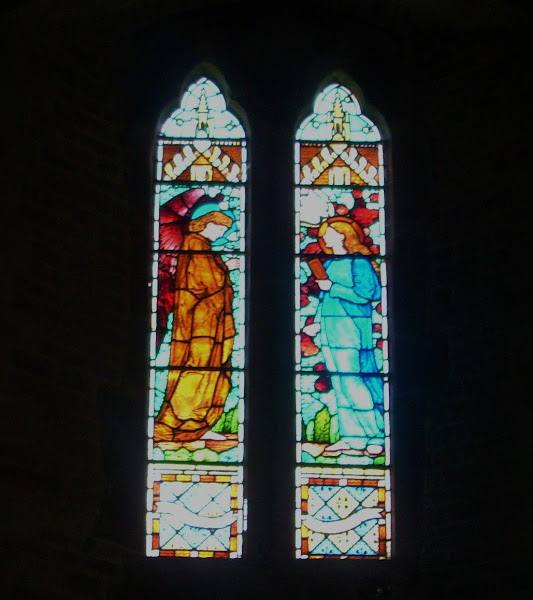
The visit was taken at Christmas, and I did not get to see the well, which was hard to locate, but I am going back there later on a warmer brighter day. From the pictures you can see we church was visited at Christmastide. It was charmingly warm and inviting, with a definite sense there is a real community at the Church. At the altar is a lovely reredos carved in wood, and pride of place given to a beautifully carved crucifix next to a carving commemorating The other carvings are equally remarkable, and most wonderful was, that the church was actually open! These were carved in memory of a beloved Rector, William Crawley a fellow of Magdalene College, Cambridge. This Anglican rector died at the age of 94, arranged for the building of a North aisle and a new chancel arch and in 1872 built the first parish school and the first bell of this school displayed in the church.The other figures on the reredos carvings are  St Peter, the disciple, Our Lady, John the Beloved Disciple and Peter shown as Pope. The carvings are of a beautiful quality.
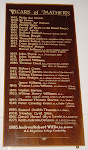
The last three priests of the Catholic Church recorded who said Mass here were
Father ADAM ap LLEWELLYN
Father GREGORY DE TREGRUG Both these priests are mentioned at the same year 1352. Possibly these were the first non monks  to become rectors following the plague, monks at Llantarnam having been reduced to a small number.
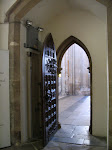
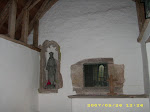
Priest's door into the Sanctuary
Fr Gregory seems to have survived as priest until 1399 when FATHER JOHN AP GRUFFYDD became the new priest. After that the records seem not to give subsequent names, but we must assume the Lord of Bergavenny appointed future priests. They seem to have all been Welshmen, because until Henry VIII ‘annexed and extirped Wales’ and the Welsh language .
this area still spoke Welsh (and possibly English as well!) the Language of the church always was Latin, as it had been from the beginning in Wales.
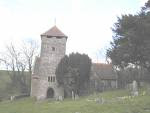
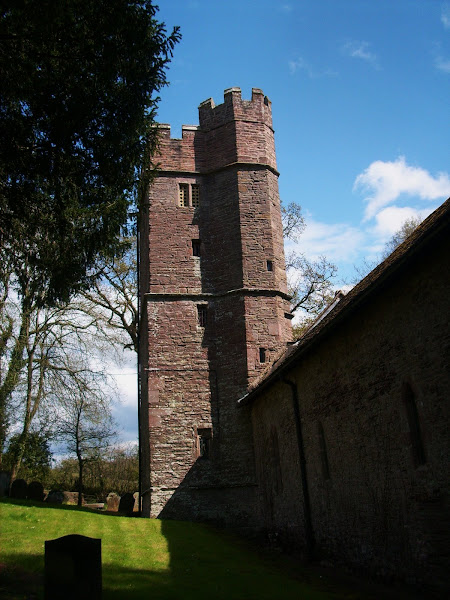
 The church has a long nave and simple chancel, which would have originally housed the sanctuary. The tower was probably added by Aeddan’s family in the thirteenth century. The Sanctuary (Chancel) was added in the fourteenth century.The Old West gallery had been removed before 1850.No tombstones in the graveyard are existant from before the 19thcentury. The church has been lovingly cared for by the Crawley family in recent centuriesand their crest is at the side of the reredos.


The original bell (Tenor) cast in Bristol about 1480 is inscribed AVE MARIA GRATIAE PLENA (Hail Mary, full of Grace) the second, commissioned in Anglican times was cast in Gloucester by John Palmer (Feare God, Honor the King-SOLI DEO DETUR GLORIA)1632 and the third bell cast in Chepstow by William Evans ‘ WM Henry Churchwarden ‘ is written on this 1766 bell. The writer of the Handbook of the Church, Mr C W Crawley also records that ropes were frequently purchased, so the bells were fully used at a time when parishioners did not have watches.
The church also possesses a silver chalice and patencover of the early Stuart Period.

< The Font
I plan to return to Bryngwyn to find the well and publish more informationon that, although I understand it is in much need of restoration.